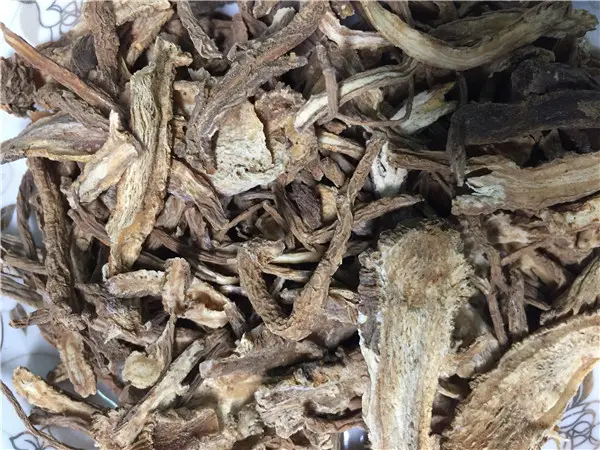
Dang Gui (Angelica root)
Dang Gui, the root of <i>Angelica sinensis</i>, is a premier herb for nourishing blood and regulating menstruation in traditional Chinese medicine.
The dried root of Angelica sinensis (Oliv.) Diels (family Apiaceae).
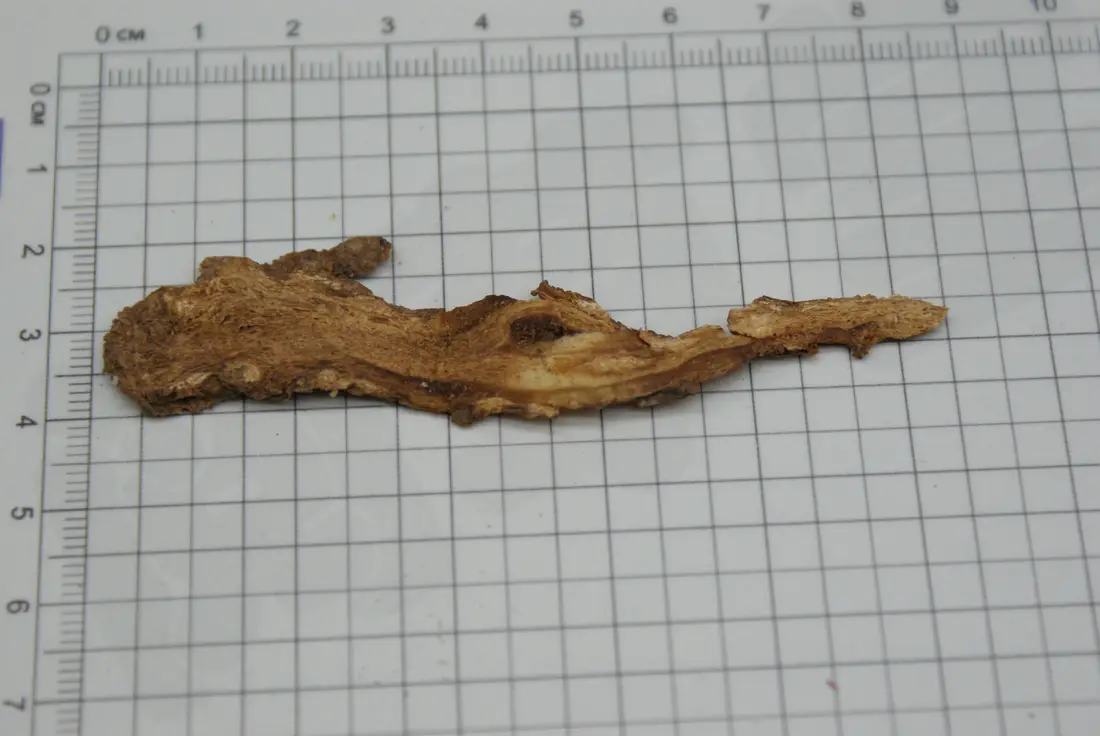
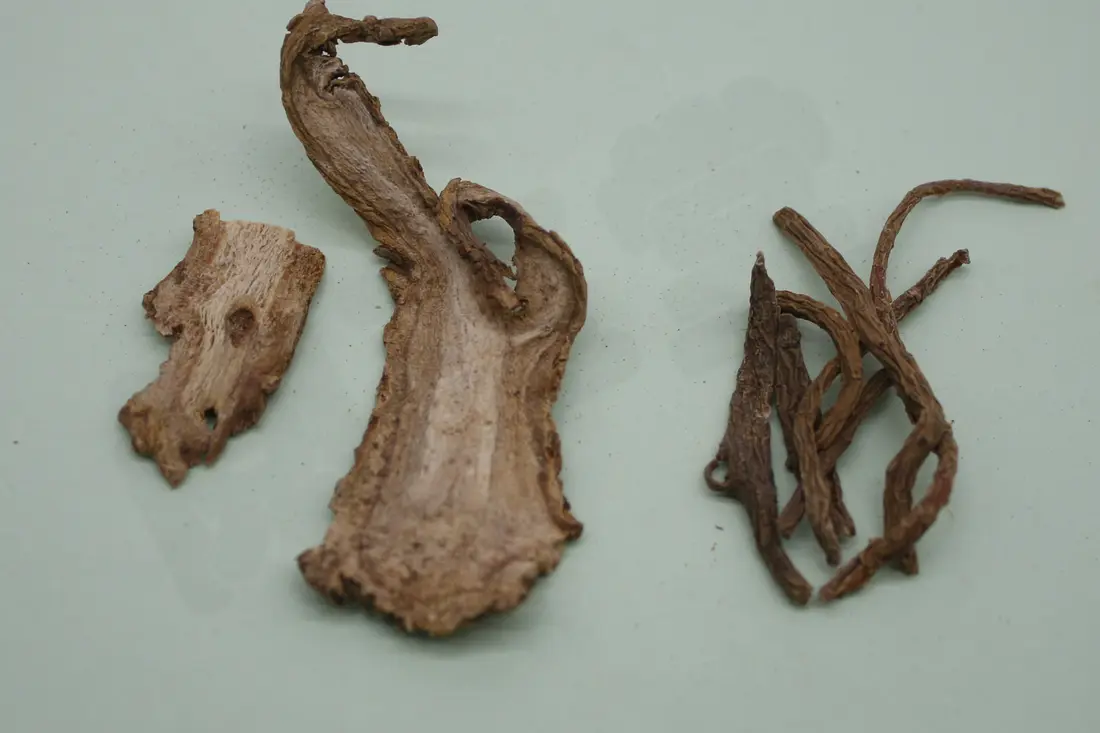
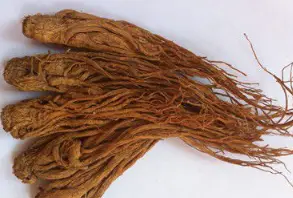
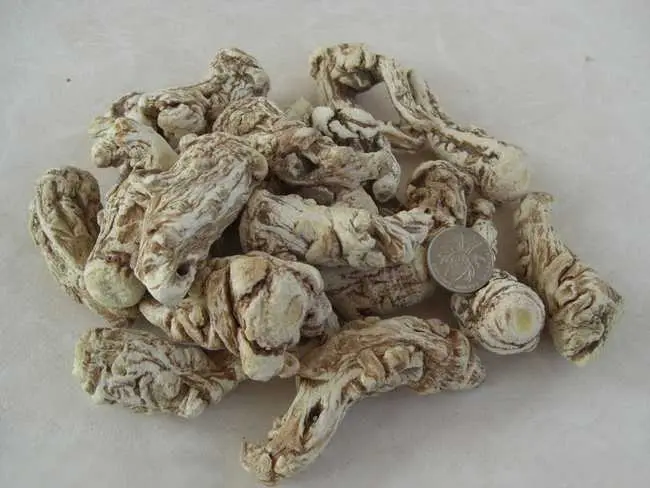
Cylindrical, with 3–5 or more rootlets, 15–25 cm long. Surface light brown to brown, with longitudinal wrinkles and transverse lenticel-like protrusions. Root head 1.5–4 cm in diameter, with annular rings, rounded at the top, or with several distinct stem scars, and remnants of purple or yellow-green stems and leaf sheaths. Main root uneven; rootlets 0.3–1 cm in diameter, thicker above and thinner below, often twisted, with a few fibrous root scars. Texture flexible; cut surface yellow-white or pale yellow-brown, cortex thick, with fissures and numerous brown dotted secretory cavities, wood lighter in color, cambium ring yellow-brown. Strong aromatic odor; taste sweet, pungent, slightly bitter. Woody, dry, oil-deficient, or greenish-brown cut surfaces are not suitable for medicinal use.
Dang Gui is a divine herb for gynecology, symbolizing marriage, offspring, and longing for one's husband. In the Song dynasty <i>Puji Benshi Fang</i>, the 'Buddha's Hand Powder' combines Dang Gui with Chuanxiong; it was said that after taking it, a dead fetus would be expelled and a live fetus would be calmed, with effectiveness like Buddha's hand, hence the name. Among the 25 most used herbs, Dang Gui ranks 8th, hence the saying 'nine out of ten formulas contain Dang Gui.' During the Three Kingdoms period, Jiang Wei's mother, upon hearing he had defected, sent him a letter of reproach. Jiang Wei, using herbal names to express his aspirations, sent back two herbs: Yuan Zhi (Polygala) and Dang Gui. His mother understood: he had远大志向 (great aspirations) and intended to restore the Han dynasty, and that the lost territory should return to Shu Han. In Sichuan's Jian Ge, there is a couplet: 'Peony is also called Li Gu, Dang Gui is also called Wen Wu.' According to <i>Gujin Zhu</i>, in ancient times, parting gifts included peony to signify leaving, and Dang Gui to express longing; when refusing to return, one sent Yuan Zhi. The <i>Wu Zhi</i> records that Cao Cao, hearing of Tai Shi Ci's fame, sent him a sealed box containing only Dang Gui, hence the origin of 'Wen Wu.' During the An Lushan Rebellion in the Tang dynasty, Emperor Xuanzong and Yang Guifei fled Chang'an; the minister Luo Gongyuan sent a brocade box, which after the rebellion was opened to reveal several stalks of Dang Gui. The emperor was overjoyed and rewarded Luo. In ancient times, a young man Wang Fu lived with his mother. He decided to go up the mountain to collect herbs and told his wife, 'If I do not return in three years, you may remarry.' Three years passed, and his mother, believing him dead, urged the wife to remarry. Less than half a month after the remarriage, Wang returned with a load of good herbs. They wept. The wife took all the herbs hoping to die, but instead her menstruation became regular. A Tang poem says, 'Just when he should return, he does not return.' There are three theories for the name Dang Gui: first, it is a geo-authentic herb from Dangzhou, and 'Qi' rhymes with 'Gui'; second, it causes qi and blood to return to their proper places; third, it is a key herb for women's health, used to regulate blood, and symbolizes longing for one's husband.
25 cultivation notes and 12 authentication articles exist for this herb. They are long-form field material and are published in Chinese only.
Chinese version · All herbs