Turmeric rhizome (Jiang Huang)
Jiang Huang
CURCUMAE LONGAE RHIZOMA
Nature and flavorPungent and bitter, warm. Enters the spleen and liver meridians.
Meridians enteredSpleen and liver
Dosage3–10 g; appropriate amount for external use.
Reference market price¥11.5 / kgBozhou market · spec common grade · 广西 · snapshot 2026-11-21
Turmeric rhizome is a warm, pungent and bitter herb used in traditional medicine to invigorate blood, dispel stasis and relieve pain.
Source药物来源
The dried rhizome of Curcuma longa L. (family Zingiberaceae).
Identification性状特征
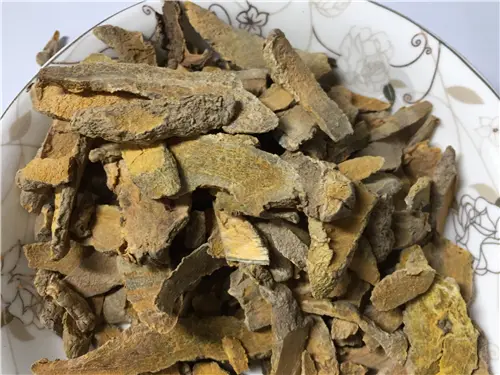
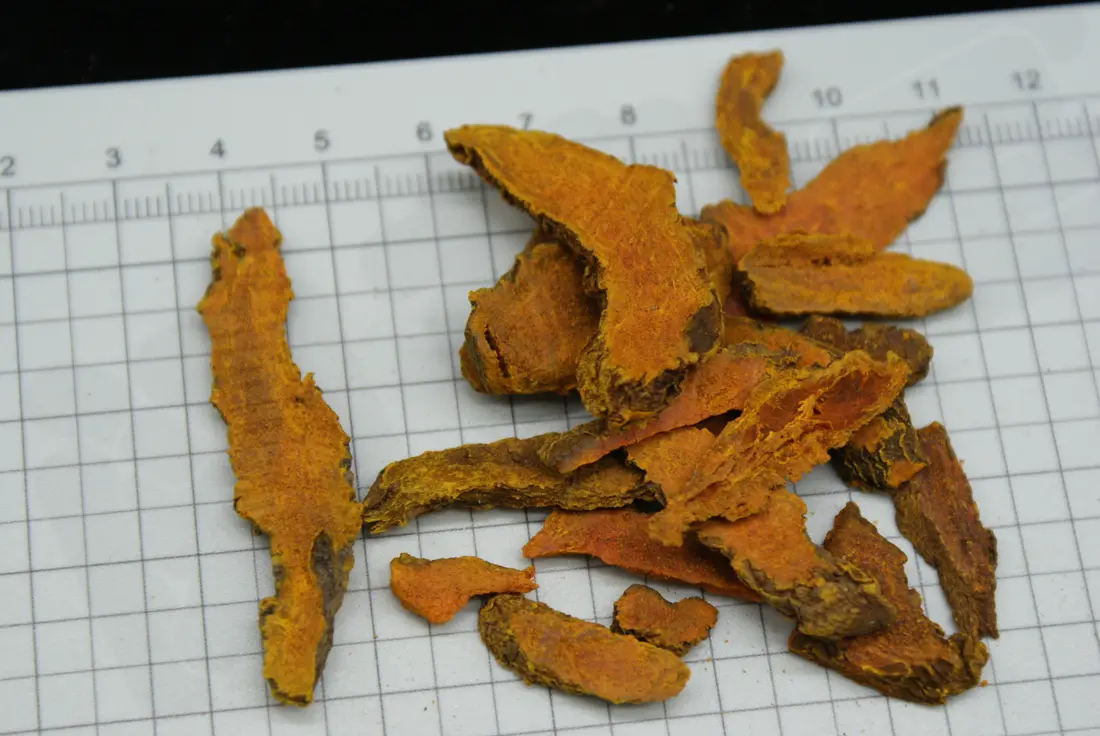
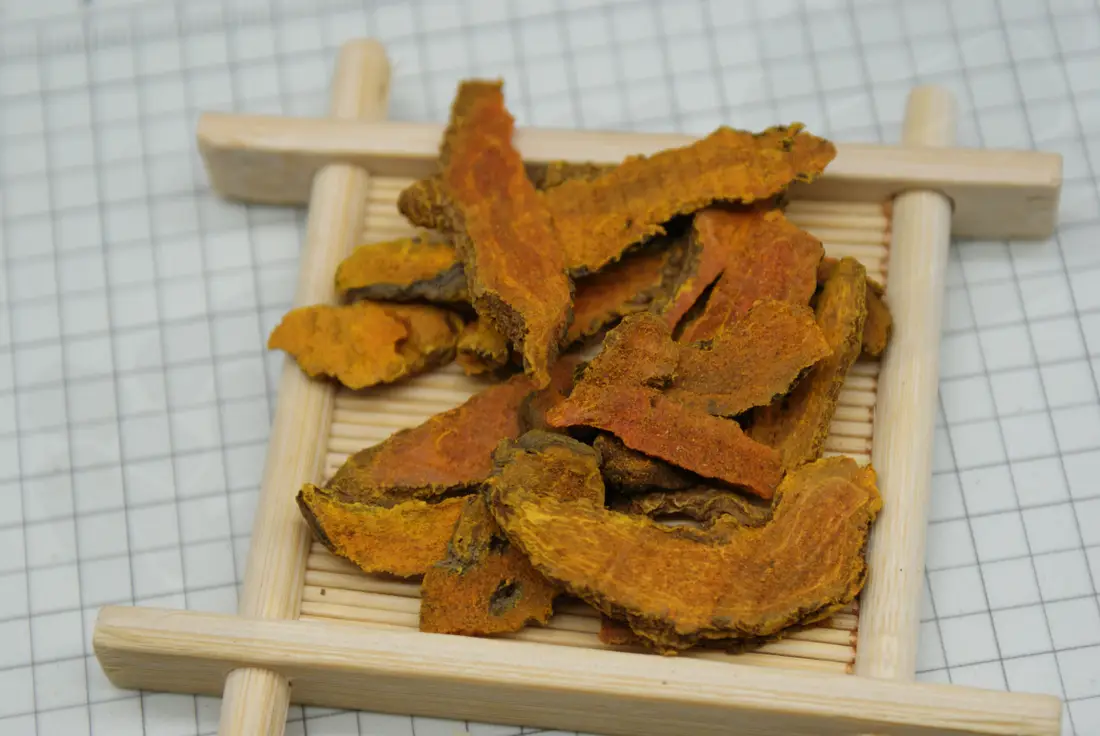
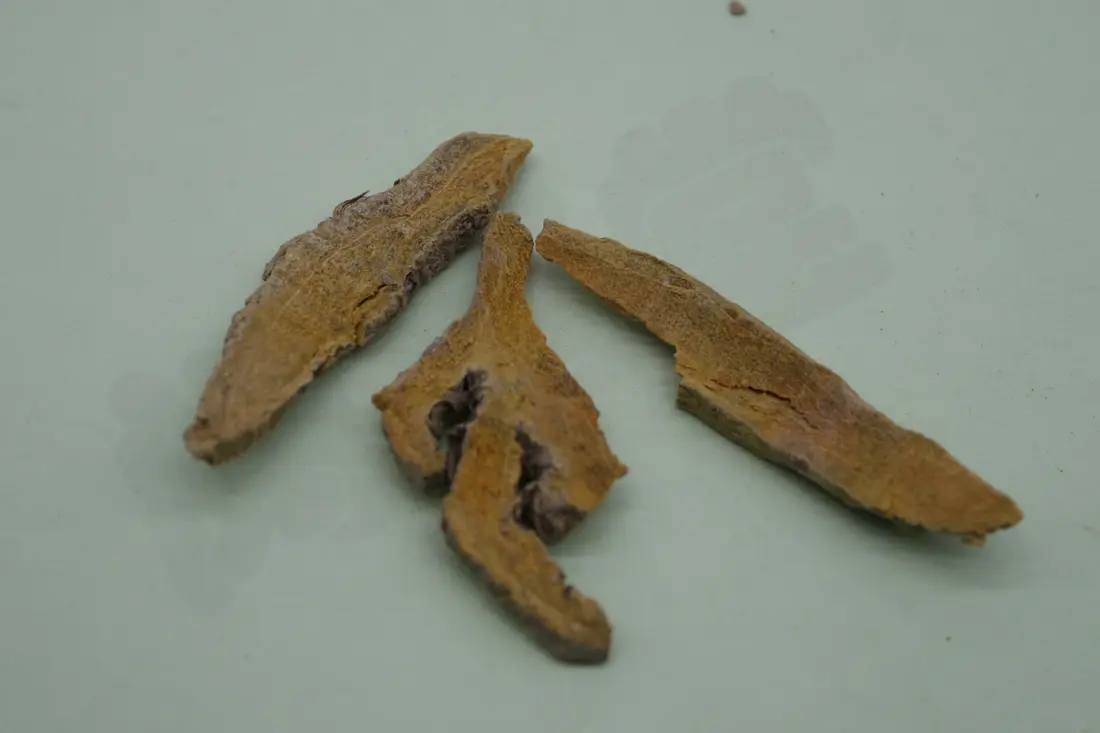
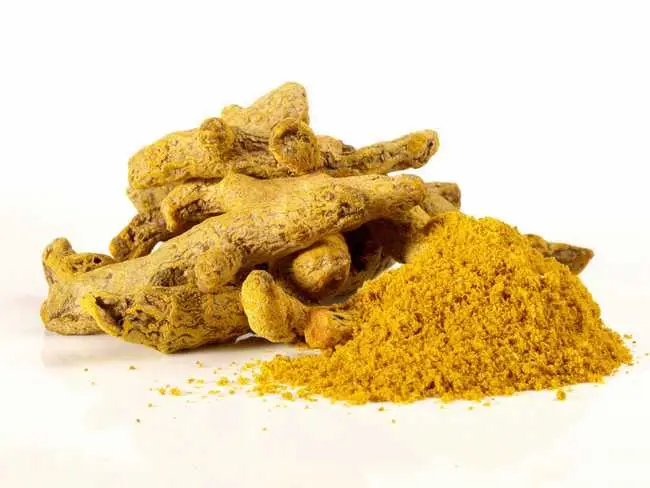
Irregular ovoid, cylindrical or spindle-shaped, often curved, sometimes with short fork-like branches, 2–5 cm long, 1–3 cm in diameter. Surface deep yellow, rough, with wrinkled texture and distinct annulations, and circular branch scars and fibrous root scars. Texture firm, not easily broken; fracture brownish-yellow to golden-yellow, horny, with waxy luster; endodermal ring distinct; vascular bundles scattered as dots. Odor characteristic, taste bitter and pungent.
Properties and actions性味与功效
ActionsInvigorates blood and dispels stasis · Promotes qi movement and relieves pain
IndicationsUsed for stabbing pain in the chest and hypochondrium, palpitation and heart pain, dysmenorrhea and amenorrhea, abdominal masses, rheumatic pain of the shoulder and arm, and swelling and pain from traumatic injury.
Dosage3–10 g; appropriate amount for external use.
CautionUse with caution in cases of blood deficiency with arm pain or abdominal pain, and in those without blood stasis or qi stagnation; misuse may further injure the blood aspect. Contraindicated in yin deficiency with heat or in patients without blood stasis.
Processing炮制
RawRemove impurities, soak briefly, wash clean, moisten thoroughly, cut into thick slices, and sun-dry.
Modern research现代药理
Cardiovascular effectsThe alcohol extract has a hypotensive effect; curcumin increases myocardial nutritional blood flow in mice.
Platelet aggregationCurcumin and the alcohol extract significantly inhibit platelet aggregation.
Lipid-lowering effectThe alcohol or ether extract, curcumin and the volatile oil all have a favorable lipid-lowering effect.
Antitumor effectCurcumin markedly inhibits tumor cells and reduces tumor incidence and carcinogenesis in animals.
Antioxidant effectCurcumin inhibits lipid peroxidation in organs.
Anti-inflammatory and analgesic effectsCurcumin has anti-inflammatory and analgesic actions.
Antimicrobial effect100% curcumin inhibits Micrococcus; the volatile oil has antifungal activity; the chloroform or ether extract inhibits Trichophyton and Microsporum gypseum in vitro.
Cholagogic effectThe extract, curcumin, volatile oil, turmerone, zingiberene, borneol and sesquiterpene alcohols all promote bile secretion.
Classical records历代本草
The Bencao Gangmu notes that Jiang Huang, Yu Jin and Zhu Yao are similar in shape and function, but Jiang Huang enters the spleen and also treats qi, and is used for wind-cold-damp arm pain. The Bencao Mengquan states it breaks blood and descends qi, resolves swellings and opens menstruation. The Bencao Jingshu warns against misuse in blood deficiency without stasis.《本草纲目》:姜黄、郁金、蒁药三物,形状、功用皆近。但郁金入心治血;而姜黄兼入脾,兼治气;蒁药则入肝,兼治气中之血,为不同尔。古方五痹汤用片子姜黄、治风寒湿气手臂痛。戴原礼《要诀》云:片子姜黄能入手臂治痛,其兼理血中之气可知。
治风痹臂痛。
《本草蒙筌》:味辛,气温。无毒。色比郁金甚黄,形较郁金稍大,论主治功力,又烈过郁金。破血立通,下气最捷。主心腹结气,并疰忤积气作膨;治产血攻心,及扑损瘀血为痛。更消痈肿,仍通月经。
《开宝本草》:味辛、苦,大寒,无毒。主心腹结积、疰忤,下气破血,除风热,消痈肿,功力烈于郁金。
《本草拾遗》:味辛,温,无毒,色黄,主破血,下气,温不寒。郁金味苦,寒,色赤,主马热病。
《本草经疏》:姜黄得火气多,金气少,故其味苦胜辛劣,辛香燥烈,性不应寒,宜其无毒。阳中阴也,降也。入足太阴,亦入足厥阴经。苦能泄热,辛能散结,故主心腹结积之属血分者,兼能治气,故又云下气。总其辛苦之力,破血,除风热,消痈肿,其能事也。日华子谓其能治癥瘕血块,又通月经,及扑损瘀血。苏颂谓其祛邪澼恶,治气胀及产后败血攻心。方书用以同肉桂、枳壳治右胁痛,臂痛,有效。戴元祛云:能入手臂治痛,何莫非下气破血,辛增苦泄之功欤?察其气味治疗,乃介乎京三棱、郁金之药也。
简误:凡病人因血虚臂痛,血虚腹痛,而非瘀血凝滞,气逆上壅作胀者,切勿误用。误则愈伤血分,令病转剧。慎之!慎之!
Cultivation and authentication栽培与鉴别
3 cultivation notes and 6 authentication articles exist for this herb. They are long-form field material and are published in Chinese only.
Read them in Chinese →