Stephania Root (Fang Ji)
Fang Ji
STEPHANIAE TETRANDRAE RADIX
Nature and flavorBitter, cold; enters the Bladder and Lung meridians.
Meridians enteredBladder, Lung
Dosage5–10 g
Reference market price¥130 / kgBozhou market · spec 带皮 · 江西 · snapshot 2026-11-21
Stephania Root (Fang Ji) is a wind-damp dispelling herb used for painful obstruction, edema, and damp-heat skin lesions.
Source药物来源
The dried root of Stephania tetrandra S. Moore (family Menispermaceae).
Identification性状特征
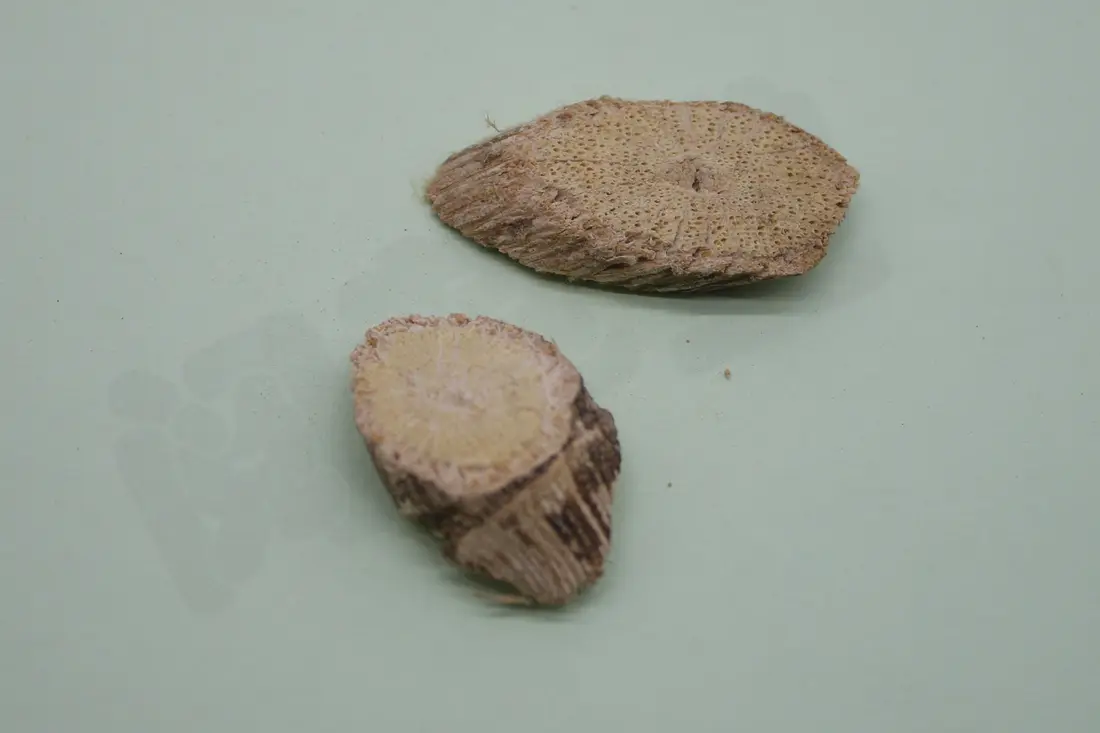
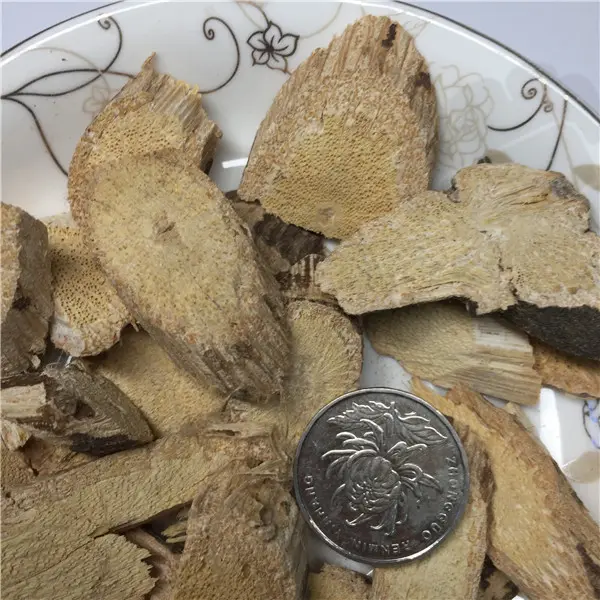
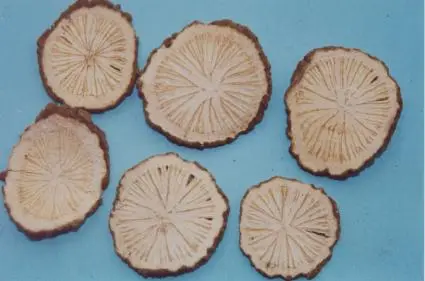
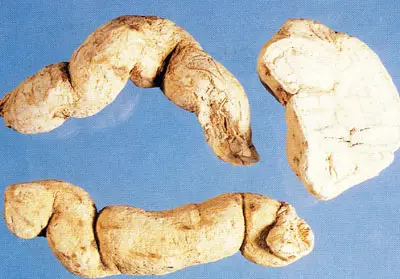
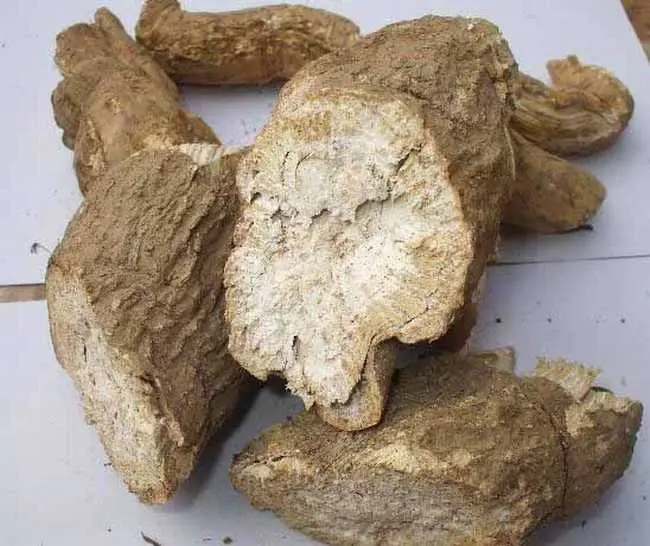
Irregular cylindrical, semi-cylindrical or lumpy, often curved, 5–10 cm long, 1–5 cm in diameter. Surface pale grayish-yellow, with deep transverse grooves at bends forming nodular swellings. Heavy, hard, fracture even and grayish-white, starchy, with sparse radial striations. Slight odor; bitter taste.
Properties and actions性味与功效
Actions
Dispel wind and relieve pain · Promote urination and reduce swelling
Indications
Used for wind-damp painful obstruction, edema, leg qi, difficult urination, and eczema with sores and toxins.
Dosage
5–10 g, decocted and taken orally.
Caution
Bitter and cold; use with caution in deficiency-cold of the spleen and stomach or yin deficiency. General reminder: not for prolonged use without professional guidance.
Processing炮制
Fang Ji slices
Remove impurities, soak briefly, wash clean, soften thoroughly, cut into thick slices, and dry.
Wine-processed Fang Ji
Take clean Fang Ji, mix evenly with wine, cover briefly until the wine is absorbed, then stir-fry over gentle heat until yellow, remove, and spread out to cool.
Modern research现代药理
Neuroprotective and sedative effects
Tetrandrine has strong protective effects against cerebral ischemia and sedative-hypnotic effects; fangchinoline has antipyretic action. Tetrandrine markedly inhibits sinus node automaticity and counteracts calcium-induced increases in contractility and oxygen consumption in animal left atrium and papillary muscle, with frequency-dependent or use-dependent effects.
Blood pressure lowering
Tetrandrine has a significant hypotensive effect; fangchinoline also lowers blood pressure but is weaker and readily induces tachyphylaxis.
Anti-platelet aggregation
Tetrandrine markedly inhibits platelet aggregation induced by various factors in animals.
Analgesic effect
Total alkaloids of Stephania tetrandra, tetrandrine, and alkaloids B and C all have analgesic effects, with the total alkaloids being the strongest.
Anti-inflammatory and anti-allergic effects
Tetrandrine and fangchinoline both have anti-inflammatory effects, with tetrandrine stronger; tetrandrine also has anti-allergic properties.
Skeletal muscle relaxation
Tetrandrine and some related compounds relax skeletal muscle.
Cytotoxic and antitumor effects
At 1:4000, tetrandrine kills 100% of Ehrlich ascites carcinoma cells in vitro and shows marked cytotoxicity against KB, Hela, and Helas cells.
Inhibition of experimental silicosis
Tetrandrine has some inhibitory effect on experimental silicosis in rats.
Antimicrobial and antiprotozoal effects
The decoction of Fang Ji is active against Shigella dysenteriae and various fungi; tetrandrine inhibits or kills Entamoeba histolytica in vitro and in vivo.
Classical records历代本草
The Shennong Bencao Jing records it as pungent and neutral, treating wind-cold, warm diseases, heat qi, and various epilepsies, and promoting urination and defecation. The Bencao Mengquan distinguishes Han Fang Ji (root) for water qi and Mu Fang Ji (stem) for wind pathogens, and warns against use in yin deficiency, qi deficiency, or upper jiao damp-heat.
《神农本草经》:味辛,平。主治风寒,温症,热气,诸痫,除邪,利大小便。
《本草蒙筌》:味辛、苦,气平、寒。阴也。无毒。通行十二经。畏萆薢杀毒雄黄,恶细辛,种因根苗各治,名分汉木两呼,汉防己是根,破之纹作车辐解,黄实馨香;木防己是苗,皮皱上有丁足子,青白虚软。汉者主水气,名载君行;音杭。木者理风邪,职佥使列。故云:腰以下至足,湿热肿痛脚气,及利大小二便,退膀胱积热,消痈散肿,非用汉者不能成功。若疗肺气喘嗽、膈间支满,并除中风挛急、风寒湿疟热邪,此又全仗木者以取效也。
谟按:东垣云:防己性苦,寒,纯阴,能泻血中湿热,通血中滞塞。补阴泄阳,助秋冬、泻春夏之药也。譬诸于人,则险而健者类之。夫险健者,每每幸灾乐祸,遇有风尘之警,必竟借为乱阶。然而见善亦喜,见恶亦怒。如善用之,可使御敌凶暴之人,冲突险固之地,亦不为无益者也。故凡瞑眩之经,圣人安得因之而使废耶!亦必存之以待善用。今夫防己闻其臭则可恶,下咽则令身心烦乱,饮食减少,药之瞑眩,诚为拇拙。至于通行十二经,以去湿热壅塞肿疼,及治下注脚气,除膀胱积热而庇其基,则非此不可,诚为行经之仙药也。然虽药力之能,亦在人善用而不错尔。复有不可用者数端,今悉举陈使知警省。如饮食劳倦、阴虚内热、元气、谷气已亏之病,而以防己泻去大便,则重亡其血,此不可用一也;如大渴引饮,是热在下焦气分,宜渗泻之,其防己乃下焦血药,此不可用二也;如外感风寒,邪传肺经,气分湿热而小便黄赤,甚至不通,此上焦气病,禁用血药,此不可用三也;若人久病,津液不行,上焦虚渴,宜补以人参、葛根之甘温,倘用苦寒之剂,则促危亡,此不可用四也。仍不止如此,但上焦湿热者皆不可用。若系下焦湿热流入十二经,以至二阴不通,必须审用可也。
《开宝本草》:味辛、苦,平、温,无毒。疗水肿,风肿,去膀胱热,伤寒,寒热邪气,中风手脚挛急,止泄,散痈肿,恶结,诸蜗疥癣,虫疮,通腠理,利九窍。
《名医别录》:味苦,温,无毒。主治水肿,风肿,去膀胱热,伤寒,寒热邪气,中风,手脚挛急,止泄,散痈肿,恶结,诸蜗疥癣,虫疮,通腠理,利九窍。
《本草拾遗》:汉主水气,木主风气,宣通。作藤著木生,吹气通一头如通草。
Audio and video语音与视频
Narration · Chinese · 7:34
Latin name · pronunciation
Photographs药材图片
Cultivation and authentication栽培与鉴别
0 cultivation notes and 5 authentication articles exist for this herb. They are long-form field material and are published in Chinese only.
Compiled from public Chinese materia medica sources for study and reference. Not medical advice.
Chinese version · All herbs
Chinese version · All herbs